Ramnagar Fort Varanasi and the Month-Long Ramnagar Ramlila
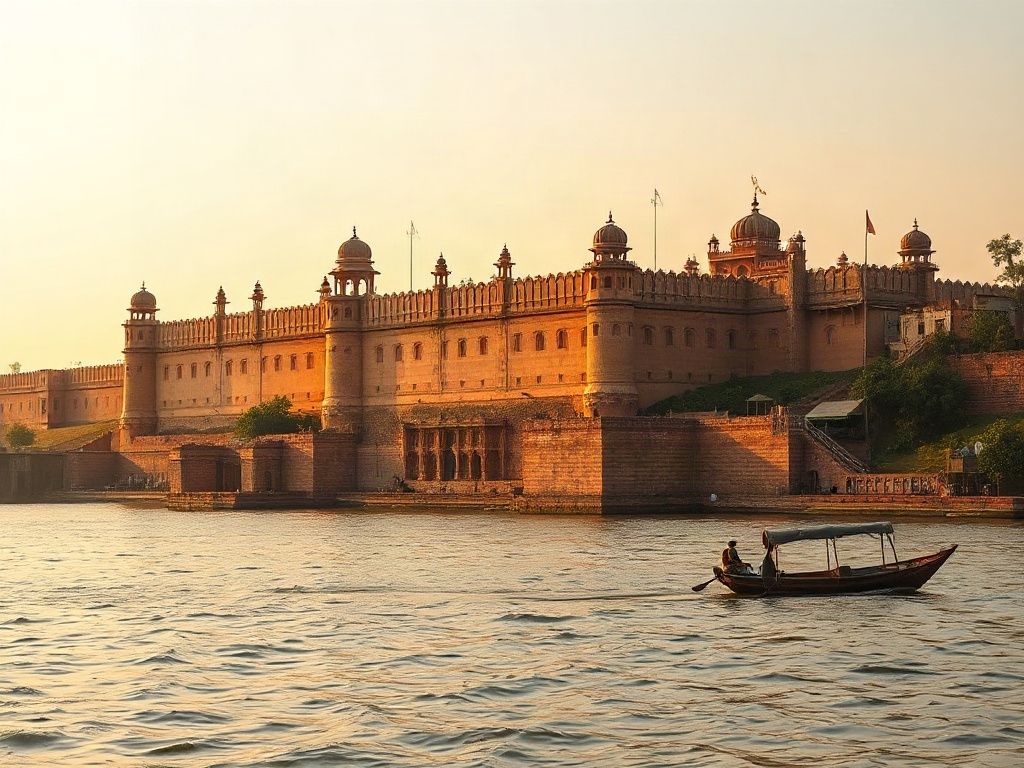
Across the Ganga from Tulsi Ghat stands Ramnagar Fort, the sandstone home of the Kashi Naresh, the former Maharaja of Benares. For most of the year it is a quiet place with a remarkable museum. For about a month each autumn, around Dussehra, it becomes the centre of the Ramnagar Ramlila — a retelling of the Ramayana performed across a whole town, by lamplight, that UNESCO counts among the most important Ramlilas in India. Here is what to know about Ramnagar Fort in Varanasi, and how to plan a visit this Dussehra season.
Key takeaways
- Ramnagar Fort, Varanasi was built in 1750 by Maharaja Balwant Singh, on the Ganga's eastern bank opposite Tulsi Ghat.
- Its museum in the old Durbar Hall holds vintage cars, an armoury and a rare 1852 astronomical clock.
- The Ramnagar Ramlila is performed across about 40 open-air sites, by lamplight, without microphones, for about a month.
- Local news reports the 2026 Ramlila began on 25 September and runs until around 25 October, ending with Ram's coronation.
- Dussehra 2026 is on Tuesday 20 October.
On this page
Ramnagar Fort Varanasi: a short history
According to the Wikipedia account of the fort, Ramnagar Fort was built in 1750 by Maharaja Balwant Singh, the Kashi Naresh, in cream-coloured sandstone. It stands close to the Ganga on its eastern bank, opposite Tulsi Ghat — which is why, from the ghats of the old city, you can see it across the water.
The fort has been the seat of the Kashi Naresh, the Maharaja of Benares, ever since. The royal title was abolished in 1971, but the family continues to live in the fort, and the Kashi Naresh still plays a central part in the Ramlila each year — traditionally attending, as the Wikipedia account describes, on a decorated elephant.
Key insight
Ramnagar Fort is not a ruin or a monument frozen in the past. It is a living royal household that still anchors one of India's oldest living festivals. That is what makes a visit in the Ramlila season so different from one at any other time of year.
The museum and the temples
The fort's museum, known as the Saraswati Bhawan, is housed in what was once the Durbar Hall, the hall of public audience. Its collection, as described in the same account, includes:
- Vintage cars, including American models
- Jewelled sedan chairs and palanquins
- Ivory work and medieval costumes
- An armoury of swords and old guns from Africa, Burma and Japan
- A rare astronomical clock, made in 1852, which shows not only the time but also the year, month, week and day
Within the fort are also a Ved Vyas temple and a south-facing Hanuman temple. By tradition, the sage Ved Vyas, who compiled the Mahabharata, is associated with Ramnagar, and the temple to him is one reason pilgrims make the crossing.
We have not printed museum timings or entry fees, because we could not find them published officially; check at the fort on the day.
The Ramnagar Ramlila
Ramlila means "Rama's play": a performance of the Ramayana in scenes of song, narration, recital and dialogue. UNESCO proclaimed it a Masterpiece of the Oral and Intangible Heritage of Humanity in 2005 and inscribed it on its Representative List in 2008. It notes that most Ramlilas last ten to twelve days, but that Ramnagar's may last an entire month, and names it among the most representative Ramlilas in India.
What sets it apart is the form. As a local report from the opening day this year described it:
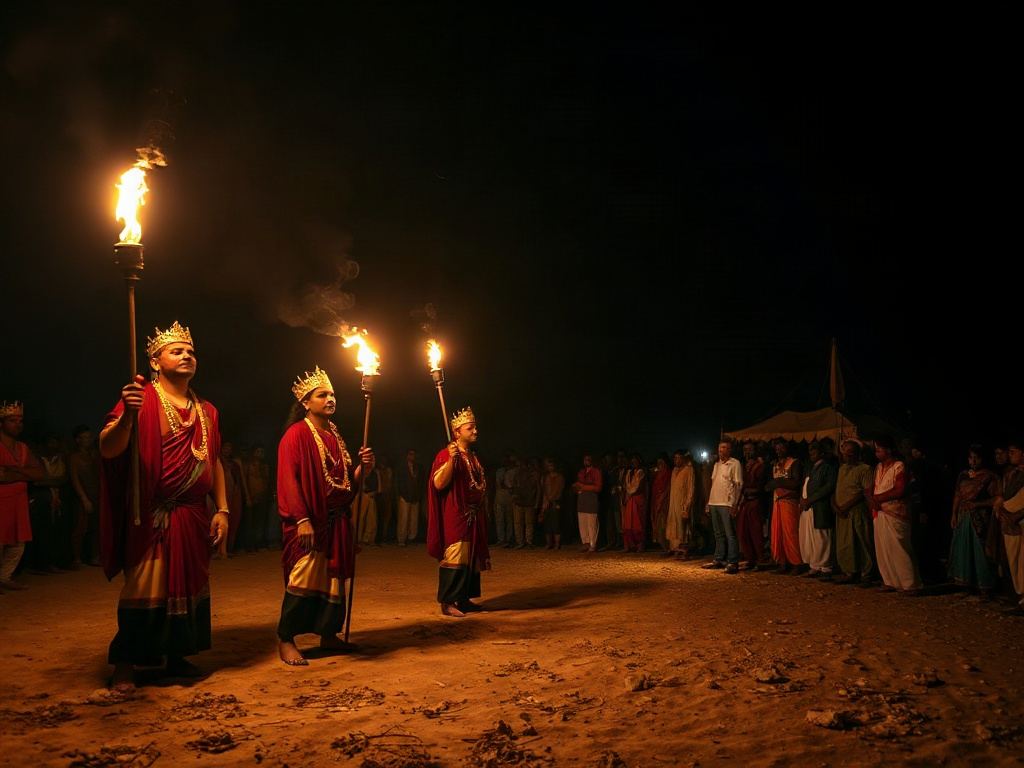
- The whole town is the stage. The lila is performed at about 40 open-air sites spread across Ramnagar and the surrounding area, each dressed as a place from the Ramayana — Ayodhya, Janakpuri, Chitrakoot, Panchavati, Lanka.
- The audience moves with the story. On different evenings, spectators walk from one site to the next as the story travels.
- No microphones, no modern lights. The lila is performed by the light of torches and petromax lamps, and the actors speak their lines in loud, clear voices.
- Around two hundred years of tradition, held under the patronage of the Kashi Naresh.
UNESCO adds that audiences are invited to sing and take part in the narration, and that Ramlila brings people together "without distinction of caste, religion or age". At Ramnagar, you will see exactly that: thousands of people standing in open fields, many following the text line by line.
Ramnagar Ramlila 2026 and Dussehra
According to local reports, the 2026 Ramnagar Ramlila began on 25 September, Anant Chaturdashi, opening with the birth of Ravan and the incarnation of Ram, and runs for about a month, ending with Ram's coronation — reported locally as around 25 October.
| Date | What |
|---|---|
| 25 September | Ramlila begins (Anant Chaturdashi) |
| 11 – 19 October | Sharad Navratri |
| 20 October (Tue) | Dussehra / Vijayadashami |
| Around 25 October | Ramlila ends with Ram's coronation, as reported locally |
Dussehra 2026 falls on Tuesday 20 October, the day after Durga Ashtami and Maha Navami, which both fall on 19 October this year. Our Navratri 2026 guide explains why.
The order of scenes at Ramnagar follows the Ramlila's own calendar, which is not published officially in a form we could verify. If you want to see a particular episode, ask locally a day or two ahead which scene falls on which evening.
How to watch the Ramlila
| Plan for | Why it matters |
|---|---|
| Arriving well before dusk | The best spots fill early, especially on major nights |
| Comfortable walking shoes | The audience moves between sites on foot |
| A torch or phone light | Lighting is traditional; paths between sites are dark |
| Water and something to sit on | Evenings can run for hours in open fields |
| Staying together | Crowds are dense and move as one |
| Following the story | Many locals carry the text; knowing the episode helps |
With elderly parents, the Ramlila is best enjoyed in small doses: one evening, a chair or cushion, and an early exit. The walking and standing are the hardest part, not the story.
Key insight
Do not try to "see the Ramlila" in one evening. It is a month-long story. Choose one or two nights, find out which episode is on, and let yourself be part of the crowd for that part of the tale.
Visiting the fort outside the Ramlila season
For most of the year, Ramnagar Fort in Varanasi is a calm half-day trip, and it pairs well with the southern ghats. A simple plan:
- Sunrise at Assi Ghat for Subah-e-Banaras, the morning programme of hymns, music and prayers to the rising sun.
- Late morning at Ramnagar Fort, for the museum, the clock and the Ved Vyas temple, before the midday heat.
- Afternoon rest, back across the river.
- Evening at the ghats for the Ganga Aarti, looking across the water towards the fort you visited that morning.
It is an easy day for families, with no long queues, and a good contrast to the crowds of the old city around Kashi Vishwanath.
Getting to Ramnagar
Ramnagar lies across the Ganga from the southern ghats of Varanasi, near Tulsi and Assi Ghat. Most visitors go by road across the river; the drive takes longer than the short distance suggests when Ramlila crowds are out. If you are staying near the ghats, our guide to where to stay near Kashi Vishwanath covers the areas, and the Assi side is the most convenient base for Ramnagar. The fort is also a fine sight from the river in the evening; our Ganga Aarti guide covers the ghats nearest to it.
For Ramlila nights, a driver who waits and brings you back is worth arranging in advance. Our verified contacts in Varanasi include drivers and stays, and connect you with them directly. If your parents are going, a MargKGB Buddy can stay with them through the crowd and help them get back safely.
What to do next
Decide whether you want to see Ramnagar Fort in Varanasi for its history and museum — any day of the year — or for the Ramlila, which is only in this autumn window. If it is the Ramlila, pick one or two evenings before 25 October, ask locally which episode is on, arrive early, and go prepared to stand, walk and listen. It is one of the oldest ways of telling the Ramayana still alive anywhere, and it is performed across the river from Kashi every year.
Frequently asked questions
Who built Ramnagar Fort in Varanasi?
Ramnagar Fort was built in 1750 by Maharaja Balwant Singh, the Kashi Naresh, in sandstone. It stands on the eastern bank of the Ganga, opposite Tulsi Ghat.
What is in the Ramnagar Fort museum?
The museum, in the fort's old Durbar Hall, displays vintage cars, jewelled sedan chairs, ivory work, costumes, an armoury of swords and old guns, and a rare astronomical clock made in 1852.
When is the Ramnagar Ramlila in 2026?
Local news reports that the 2026 Ramnagar Ramlila began on 25 September, Anant Chaturdashi, and runs for about a month, until around 25 October, ending with Lord Ram's coronation.
What makes the Ramnagar Ramlila special?
It is performed across about 40 open-air sites in and around Ramnagar, each dressed as a place in the Ramayana, by the light of torches and lamps, without microphones. UNESCO lists Ramlila as Intangible Cultural Heritage and names Ramnagar among its most representative forms.
When is Dussehra 2026?
Dussehra, or Vijayadashami, is on Tuesday 20 October 2026, the day after Durga Ashtami and Maha Navami, which both fall on 19 October this year.