Ganga Aarti at Varanasi: Which Ghat, What Time, and Where to Sit
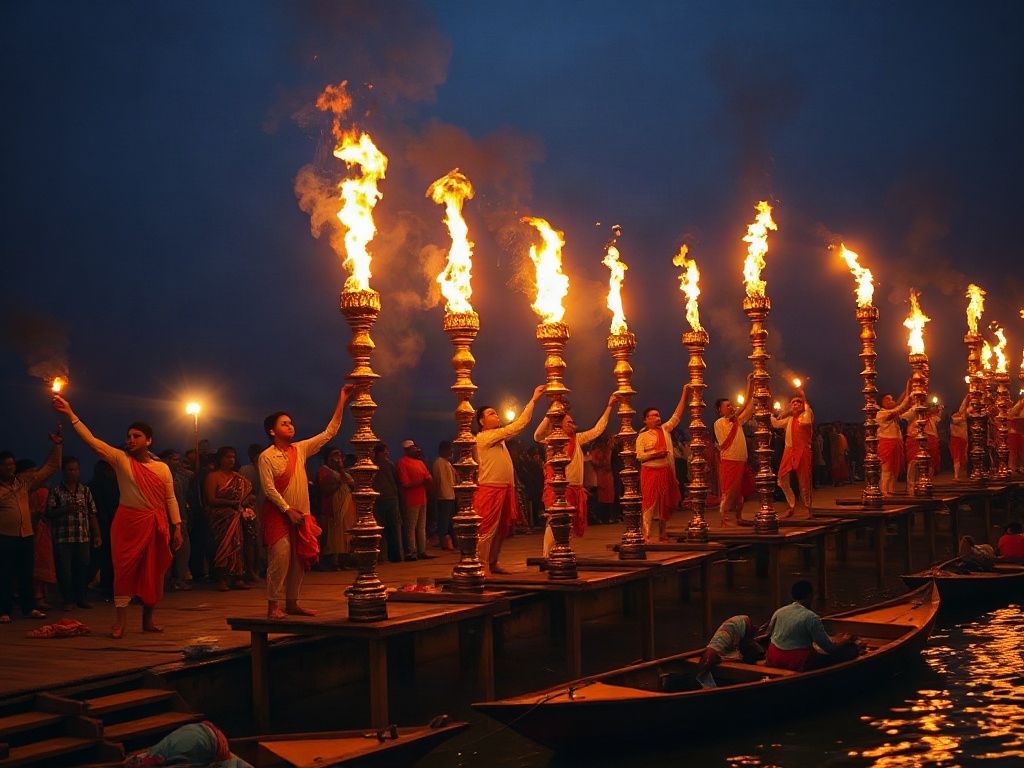
The evening Ganga Aarti at Varanasi is the moment most visitors carry home: rows of priests raising great flaming lamps in unison as the light goes and the river turns gold. It is held every evening at Dashashwamedh Ghat, and in a calmer form at Assi Ghat. What confuses people is the time — because there isn't a fixed one. This guide explains which ghat to choose, how to plan around sunset, and how to watch the aarti without spending it squeezed into a crowd.
Key takeaways
- The grand evening Ganga Aarti at Varanasi is held at Dashashwamedh Ghat every evening; Assi Ghat holds a calmer one.
- There is no official start time. The aarti begins around sunset, which moves by about 1 hour 40 minutes across the year.
- Arrive about 45 minutes before sunset for a place on the steps or a well-placed boat.
- There is no official VIP ticket. The aarti is free to watch; boat and platform seats are sold privately.
- Subah-e-Banaras at Assi Ghat is the sunrise programme, if you prefer mornings.
On this page
- Where the Ganga Aarti at Varanasi is held
- Dashashwamedh or Assi: which ghat to choose
- What time does the Ganga Aarti start?
- Steps, boat or rooftop: where to watch from
- Festival evenings, when the aarti is grander
- Subah-e-Banaras: the morning alternative
- Watching the aarti with elderly parents or children
- Frequently asked questions
Where the Ganga Aarti at Varanasi is held
The best-known Ganga Aarti is at Dashashwamedh Ghat, the busiest ghat in the city, a short walk from Kashi Vishwanath. The Kashi official portal calls the ghat "world-famous for hosting the grand Ganga Aarti every evening", performed by a group of priests in traditional dress with large lamps, incense, flowers and the sound of conch shells.
The ghat's name comes from its legend. The portal records the belief that Lord Brahma performed a yajna of ten horses — dasha ashwamedha — here to welcome Lord Shiva to Kashi, which is why it is counted among the holiest ghats in India.
A second evening aarti is held at Assi Ghat, at the southern end of the riverfront, where the Assi river meets the Ganga. The portal's page on Assi Ghat describes it as similar to the Dashashwamedh aarti but "in a more peaceful setting", and a favourite for people who want a less crowded experience.
Dashashwamedh or Assi: which ghat to choose
| Dashashwamedh Ghat | Assi Ghat | |
|---|---|---|
| The aarti | The grandest, best-known evening aarti | A similar aarti, on a smaller scale |
| Crowd | Very large, every evening | Noticeably calmer |
| Near | Kashi Vishwanath, the old city | BHU, cafés and guesthouses |
| Also known for | Festival celebrations, boat rides | Subah-e-Banaras at sunrise |
| Best for | Seeing the full spectacle once | A quieter evening, or a second visit |
If you are in Varanasi for only one evening, go to Dashashwamedh — it is the aarti the city is known for. If you have more than one evening, or are travelling with someone who finds crowds hard, try Assi on the other night. Many families say the quieter one is the one they remember.
Key insight
The Dashashwamedh aarti is designed to be seen from the river as much as from the steps. The priests face the Ganga. If you sit on the steps behind them, you see their backs and the lamps; from a boat, you see their faces. Decide which you want before you choose where to sit.
What time does the Ganga Aarti start?
This is the question people search for most, and the honest answer is that no government or temple source publishes a fixed start time. The aarti is tied to dusk, so it begins around sunset — and sunset in Varanasi moves by well over an hour and a half across the year.
To help you plan, here is the time of sunset in Varanasi on the 15th of each month in 2026:
| Month | Sunset in Varanasi | Month | Sunset in Varanasi |
|---|---|---|---|
| January | 5:29 PM | July | 6:50 PM |
| February | 5:51 PM | August | 6:33 PM |
| March | 6:06 PM | September | 6:02 PM |
| April | 6:20 PM | October | 5:30 PM |
| May | 6:35 PM | November | 5:09 PM |
| June | 6:49 PM | December | 5:10 PM |
These are astronomical sunset times for Varanasi, which we cross-checked against the city-specific panchang times we verify for festivals. Use them this way:
- Arrive about 45 minutes before sunset if you want a place on the steps.
- Board a boat about 30 minutes before sunset if you are watching from the river.
- Ask your host or driver on the day. Locally, everyone knows roughly when that evening's aarti will begin.
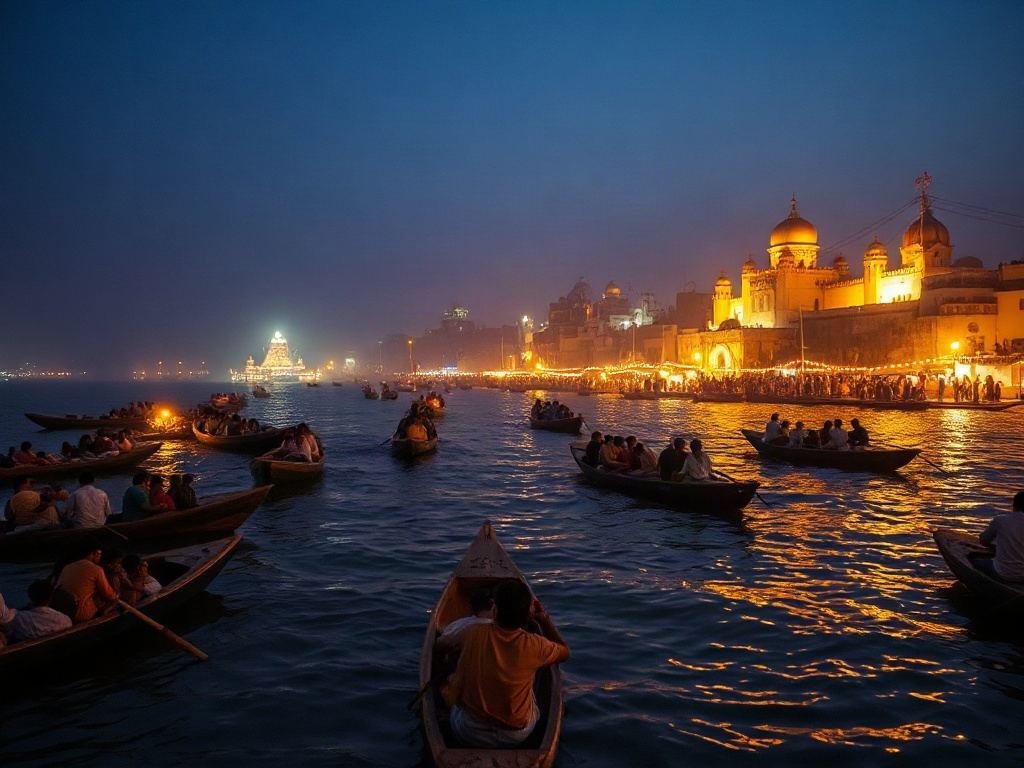
Steps, boat or rooftop: where to watch from
| Where | What you see | What to know |
|---|---|---|
| The ghat steps | The lamps and the river beyond, from behind the priests | Free; arrive early; very crowded |
| A boat on the river | The priests' faces and the whole ghat lit up | Fares are set privately; agree before boarding |
| A rooftop or balcony nearby | The whole scene from above | Some cafés and guesthouses have them; ask in advance |
On boats. Boats gather in front of Dashashwamedh before the aarti and stay for it. Neither the Kashi portal nor any other official source publishes boat fares, so agree the fare, and how long the boat will stay, before you step in. With elderly parents, check how you will get into and out of the boat — the steps down to the water are steep and often wet.
On "VIP" seats. You may be offered VIP seats or VIP passes for the aarti. There is no official VIP ticket. Some operators sell seats on platforms or boats; that is a private arrangement, not a temple or government service, and it should be priced and agreed like any other.
Festival evenings, when the aarti is grander
On certain days the evening aarti becomes something much larger. The Kashi official portal names Dev Deepawali, Kartik Purnima and Ganga Dussehra as the festivals when Dashashwamedh becomes "the epicentre of grand celebrations, with lakhs of lamps illuminating the entire stretch of the river".
In 2026, Dev Deepawali falls on Tuesday 24 November, on Kartik Purnima. It is the most spectacular evening of the year on the ghats — and the most crowded by far. If you plan to be in Varanasi for it, book your stay well ahead, and expect boats, rooftops and steps all to be full hours before dusk.
Late October brings a different kind of crowd. The Indian Air Force's aerial display over the Ganga is set for Sunday 25 October at Namo Ghat; our guide to the Varanasi air show explains what is confirmed. On a day like that, plan the evening aarti knowing that the riverfront will already be busy.
Subah-e-Banaras: the morning alternative
If evenings are too crowded, or if you are an early riser, go to Assi Ghat at sunrise. The Kashi portal describes Subah-e-Banaras, the "Morning of Banaras", as beginning with Vedic hymns, followed by classical music, yoga, and prayers to the rising sun and the river. It is gentler than the evening aarti, and the light on the river at dawn is extraordinary.
Sunrise in Varanasi is around 5:56 AM in mid-October and around 6:15 AM in mid-November, so plan to reach Assi Ghat a little before that.
Key insight
For families with elderly parents, Subah-e-Banaras is often the better choice. The crowd is smaller, the steps are easier to manage in daylight, and it leaves the evening free for rest — or for darshan at Kashi Vishwanath.
Watching the aarti with elderly parents or children
The Dashashwamedh aarti is beautiful and it is crowded. A little planning makes the difference:
| Plan for | Why it matters |
|---|---|
| Arriving early and sitting down | Standing through a long aarti in a crowd is tiring |
| A boat instead of the steps | Parents can sit throughout, with a clear view |
| Keeping the group together | The crowd surges when the aarti ends |
| A torch or phone light | The lanes back from the ghat are dim and uneven |
| Leaving a few minutes early | Or waiting for the crowd to clear |
Our Kashi Vishwanath timings guide explains how to fit darshan and the aarti into the same day. If your parents are making the trip without you, a MargKGB Buddy can stay with them from the ghat to the boat and back through the crowd. Our verified contacts in Varanasi include drivers and stays near the ghats, and connect you with them directly.
What to do next
Decide between Dashashwamedh and Assi, check the sunset for the month you are travelling, and plan to arrive about 45 minutes before it. If you want a boat, agree the fare before you board. And if the evening crowd is too much, come back at sunrise for Subah-e-Banaras. The Ganga Aarti at Varanasi happens every day — there is no need to see it in a rush.
Frequently asked questions
Which ghat is best for Ganga Aarti in Varanasi?
Dashashwamedh Ghat hosts the grandest and best-known evening Ganga Aarti, and the district's official portal calls it world-famous for it. Assi Ghat holds a calmer evening aarti and the Subah-e-Banaras programme at sunrise. Choose Dashashwamedh for the spectacle and Assi for a quieter experience.
What time is Ganga Aarti in Varanasi?
No official source publishes a fixed time, because the aarti begins around sunset and sunset moves through the year — from about 5:10 PM in November and December to about 6:50 PM in June and July. Arrive around 45 minutes before sunset for a place on the steps.
How much does a VIP ticket for Ganga Aarti cost?
There is no official VIP ticket. The Ganga Aarti is free to watch from the ghats. Seats on boats and on some platforms are sold by private operators, and no official price exists for them. Agree any fare before you pay.
Is there Ganga Aarti today in Varanasi?
The Kashi official portal describes the Ganga Aarti at Dashashwamedh as held every evening. When the river is very high, arrangements can change, so check locally during and just after the monsoon.
What is the best time to visit Ganga Aarti?
Arrive about 45 minutes before sunset to find a place on the steps or a boat in a good position. October to March is the most comfortable season, and the aarti is especially grand on festival days such as Dev Deepawali.
What is Subah-e-Banaras at Assi Ghat?
It is the morning programme at Assi Ghat, held at sunrise. The Kashi official portal describes it as beginning with Vedic hymns, followed by classical music, yoga, and prayers to the rising sun and the Ganga.